Moto Bike Stunt Wheelie Game
- 4.2
- Rating
- 10.00M
- Installs
- Free
- Price

 Analysis by App-foxy
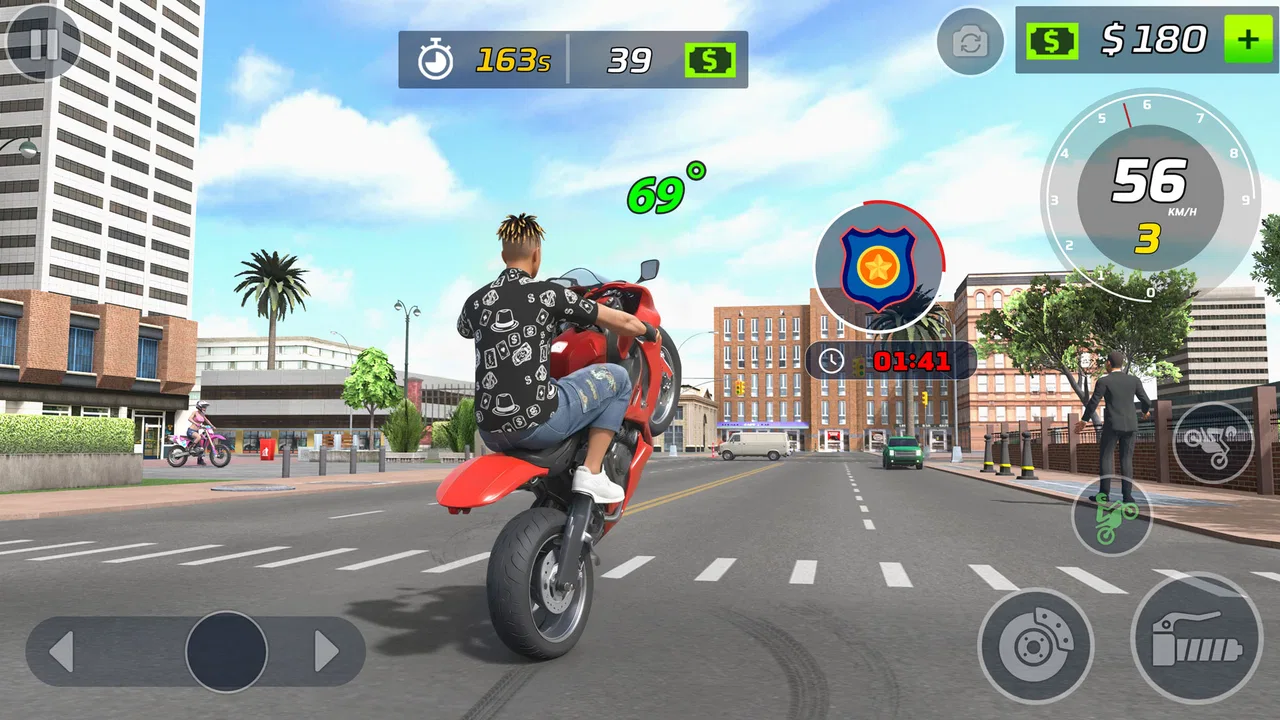
I spent time with Moto Bike Stunt Wheelie Game as a quick, stunt-focused sports game, and my first impression was clear: it is built around the simple pleasure of keeping a motorcycle balanced while attempting dramatic jumps and wheelies. That narrow idea gives it an immediate appeal, especially when I only have a few minutes and want something more active than a puzzle but less demanding than a full racing simulation.
The game is free to install, although optional in-app purchases range from $0.99 to $14.99 per item. It comes from Game town and is listed for Teen players. Its current version is 1.2, and it can run on devices using Android 7.0 or later. Those details make it approachable for people with older compatible phones, but the experience still depends heavily on how comfortably a player can see moving obstacles and react to rapid changes on screen.
How clearly the game communicates what is happening
The basic premise is easy to understand without a long learning period. I do not need to study a complicated sports rulebook before trying a stunt. The visual focus is the motorcycle, the track, the jump, and the timing of my movement. That direct presentation is one of the strongest parts of the game because it reduces the amount of reading required before play begins.
You May Also Like

 Google Keep - Notes and lists
Google Keep’s Quiet Growth Shows the Appeal of Simpler Notes
As mobile work gets busier, Google Keep keeps winning a simple contest: capture a thought quickly, find it later, and get on with the day.

 Blood Strike: 2.5 Anniversary
Blood Strike’s Loadouts Turn Every Drop Into a Tactical Gamble
A close look at Blood Strike’s custom loadouts: how fast access to signature weapons reshapes its battle royale rhythm, rewards preparation, and narrows the gap between fights.

 Pandora - Music & Podcasts
Pandora’s Music Is Easy to Start, but Harder to Recover
Pandora’s strength is its low-effort path from a seed to a station. Its weak spot is how much confidence it asks you to place in connection, setup, and quiet recovery.

 8 Ball Pool
 Is Built on Rivalries, Rematches, and Routine
A close look at the rivalries, rematches, shared routines, and unanswered safety questions that turn a quick pool match into a persistent mobile community.

 Samsung Music
’s Quiet Strength Is Playing What You Already Own
Its reach comes less from spectacle than from dependable access to a personal library. That simplicity is both the app’s strongest retention engine and its ceiling.

 AccuWeather: Weather Radar
AccuWeather Review: A Quick, Clear Forecast for Everyday Decisions
For everyday plans, the best forecast is the one you can understand quickly. AccuWeather makes rain timing, radar, and local conditions easy to act on, with a few trade-offs.
More From Our News Desk



For players who prefer visual instructions, this kind of design can be comfortable. The action itself shows the relationship between balance and momentum, so I can learn by watching what the bike does after each attempt. A short session also makes it practical to stop, adjust my grip, and try again rather than commit to a long match.
At the same time, a stunt game can become visually busy very quickly. A motorcycle moving through a jump needs constant attention, and players with reduced vision may find it harder to distinguish the bike from the background or judge the exact landing point. I found that playing on a larger screen was more comfortable than relying on a small phone display, particularly when I was concentrating on the bike’s position instead of the surrounding scenery.
Navigation is most accessible when I treat the game as a focused action experience rather than a menu-heavy sports package. I would recommend taking a moment to identify the main play option and any purchase-related prompts before starting a serious session. That small habit matters for anyone who needs extra time to read or who finds sudden screen changes distracting.
The clearest strength is its low conceptual barrier: the player understands the goal through the action itself. That does not mean every control or visual element will suit every player. It means the game gives beginners a reasonable starting point without requiring prior knowledge of motorcycle games.
Reading the screen without losing the stunt
Readability is not only about text size. In this game, the more important question is whether I can follow the bike, the ramp, and the landing area at the same time. Someone with attention difficulties may benefit from short attempts because the game asks for one immediate decision rather than a long chain of strategic choices.
Players who are sensitive to visual motion should approach it differently. The repeated movement of a motorcycle, sudden jumps, and quick changes in direction may be tiring during extended play. I would use brief sessions, lower the device brightness to a comfortable level, and avoid playing while already feeling motion-sensitive. These are practical adjustments rather than special game settings, but they can make the experience easier to manage.
For users who rely on audio cues, I would not make sound the only way to understand a stunt. The essential information is presented through the moving image, so visual attention remains important. This may suit players who prefer to keep the volume low or play in a quiet public place, but it also means that anyone who cannot comfortably track fast on-screen movement may face a bigger challenge.
Control demands and different motor abilities
Bike stunt games are naturally dependent on timing, pressure, and quick corrections. I found that success comes less from holding a control continuously and more from making small adjustments at the right moment. That creates a satisfying learning curve, but it can be demanding for players with limited finger movement, tremors, pain, or difficulty performing repeated taps and swipes.
A useful approach is to hold the phone securely on a table or stable surface instead of trying to play one-handed while walking or standing. This reduces the physical effort needed to keep the device steady and leaves the playing hand free to concentrate on control. It also makes the game safer in everyday situations, since looking down at a moving stunt while walking is a poor combination for any player.
People who use a stylus may find precise interaction easier, depending on the device and the way its touch controls respond. I would test the controls during low-pressure attempts before deciding whether the game is physically comfortable. If a player needs large, slow, or remappable controls, this may not be the right choice, because the core challenge depends on timely interaction rather than relaxed navigation.
The game’s appeal changes significantly according to motor ability. For someone who enjoys practicing small finger movements, the need for controlled corrections can feel rewarding. For someone whose hands fatigue quickly, the same design may turn a short game into an uncomfortable task. I would not judge the experience by whether a player can complete the hardest stunt; I would judge it by whether the basic control motion remains comfortable after several attempts.
Sound, focus, and sensory comfort
The visual motion is the main sensory consideration. A player who enjoys energetic sports presentation may find the movement motivating, while someone sensitive to rapid animation may need to limit session length. I would avoid assuming that a quiet room automatically makes the game easier, because the screen itself remains active and demanding.
Playing with headphones can help some users focus, but it is not automatically better. Headphones may isolate the player from nearby conversations or environmental sounds, which is useful in a controlled setting but less suitable when awareness of the surroundings matters. For a child or teenager playing at home, speaker volume and session duration are worth considering even though the game is easy to start.
Another practical point is fatigue. When I become tired, I make larger and later corrections, which is exactly when a precision stunt game becomes frustrating. Players with sensory or concentration limits may get more from a planned routine of short sessions than from trying to force progress in one long sitting. The game works well as a small break; it is less convincing as an activity that demands hours of continuous attention.
Where it fits into everyday situations
I can imagine using this game during a short wait, after finishing a task, or while relaxing at home with only one hand free for the phone. Its sports category gives it more immediate action than a turn-based game, but each attempt can still feel self-contained. That makes it convenient when I do not want to remember a complicated story or maintain progress across a long session.
A realistic example would be a commuter waiting for a delayed bus. I could sit down, play a few stunt attempts, and stop as soon as the bus arrives without leaving a team, race, or multiplayer session unfinished. The same situation could work for a player who needs frequent breaks because the game’s central activity is easy to resume. I would not play it while standing near traffic, crossing a street, or moving through a crowded station, because the required visual focus makes that unsafe.
At home, the game may suit a shared-device routine where different family members take short turns. The Teen content rating is important here: I would treat it as a game aimed at older children and teenagers rather than assuming it is designed for very young players. Parents can also decide whether the optional purchases fit their household rules before allowing unsupervised play.
For players with limited energy, the short-attempt format may be more manageable than a long racing game. However, the physical and visual demands do not disappear simply because a session is brief. A player who needs frequent pauses should use those pauses early, before hand strain or screen fatigue makes the controls harder to manage.
What it offers compared with other sports games
Compared with a conventional racing game, this title feels more concentrated. I am not mainly choosing a vehicle, studying a circuit, or managing a long competition. The satisfaction comes from the stunt itself: approach, lift, balance, and landing. That focus makes it easier to understand, but it also gives the game less variety than a broader motorcycle racer might provide.
Compared with a realistic motorcycle simulator, it is a more casual option. Players who want detailed handling, technical tuning, or a deep career structure should look elsewhere. Those alternatives may offer more control over the riding experience, but they can also place heavier demands on reading, memory, and sustained attention. This game is better for someone who wants a direct physical challenge without learning a large system first.
Compared with ordinary arcade sports games, the wheelie-and-stunt concept gives it a distinctive rhythm. The trade-off is that repeated attempts can feel similar if the player does not enjoy refining timing. I would choose it over a standard racer when I want a quick test of control, but I would choose a larger racing game when I need broader content or a more varied sense of progression.
The public response is encouraging, with an average rating of 4.4 from around 3.8 thousand ratings and more than 10 million installs. I see that reach as evidence that the simple stunt idea connects with a large audience, not as proof that it will suit every ability or device. The game’s popularity does not remove the need to consider visual motion, touch precision, and purchase prompts.
Where the experience still creates barriers
The biggest barrier is the dependence on rapid visual judgment. Players with low vision, strong motion sensitivity, or difficulty tracking moving objects may struggle even if the menus are understandable. A game can have a simple objective and still be inaccessible in practice when the central task requires constant visual correction.
Motor demands are another limitation. If a player cannot comfortably make repeated small touch movements, there is little room to bypass the main challenge because balancing the bike is the game rather than an optional feature. I would be cautious about recommending it to someone looking for relaxed sports play, especially if they already know that fast touch controls cause pain or fatigue.
There is also a situational barrier for people who need predictable, low-distraction environments. The game may be easy to start, but the action can pull attention away from surroundings. It is not a good fit for playing during mobility, supervision duties, or any moment when the player must respond quickly to another person or event.
Optional purchases deserve a practical mention as well. The game is free to begin, but the presence of items priced from $0.99 to $14.99 means I would review purchase settings before handing the phone to a younger player. Someone who wants a completely purchase-free experience may prefer a paid game with no optional transactions, even if that means paying upfront.
Device age can also affect comfort. Android 7.0 compatibility is helpful for people who keep older phones, but an operating-system requirement alone does not tell me how large, bright, or responsive a particular device will feel during play. A technically compatible phone may still be tiring if its screen is small or its touch response is inconsistent.
Who I would recommend it to
I would recommend it to players who enjoy motorcycle stunts, short arcade challenges, and learning through repeated attempts. It is especially suitable for someone who wants a free sports game with a clear central idea and does not need a deep simulator or an elaborate competitive structure.
I would also suggest it to players who like self-paced improvement. The game rewards noticing how a small timing change affects a landing, so patient experimentation is more useful than rushing. A practical tip is to change only one part of an attempt at a time: adjust the start of a wheelie, then observe the landing, instead of changing every movement at once. That makes failures easier to understand and gives the practice more purpose.
I would skip it for anyone seeking calm, low-motion gameplay, extensive accessibility controls, or a detailed motorcycle simulation. I would also choose another game for a child below the Teen rating, for a player who cannot comfortably follow fast movement, or for someone who wants a fully hands-off experience with minimal touch precision.
For friends who ask whether it is worth trying, my answer is yes if the appeal is specifically stunt timing. The free entry makes experimenting easy, while the compact concept prevents the first session from feeling like homework. I would simply set a spending boundary, play in a safe seated position, and stop when the controls begin to strain my hands or eyes.
My inclusive verdict after playing
Moto Bike Stunt Wheelie Game succeeds because it does not hide its main idea behind complicated systems. I can start quickly, understand the objective through the action, and use short sessions to practice. Game town has made a sports game that is approachable in concept and appealing to a wide range of casual players, which helps explain its strong reach and 4.4 average rating.
Its inclusiveness has limits, though. The same fast motorcycle movement that makes the stunts exciting can challenge players with visual, sensory, or motor limitations. The game is most comfortable for people who can track a moving bike, make timely touch corrections, and control their playing environment. It is less suitable for anyone who needs slow interaction, extensive control customization, or minimal visual motion.
My final recommendation is therefore conditional but positive: try it if you want a free, direct motorcycle stunt game and your hands and eyes are comfortable with quick repeated adjustments. Use a stable surface, keep sessions short when needed, and decide in advance whether optional purchases are appropriate. For a player whose priorities are relaxed access, deep simulation, or broad control flexibility, another sports game will be a better choice. For everyone else, this is a focused little challenge that earns its place as a quick way to turn a spare moment into a test of balance and timing.
FAQs for Moto Bike Stunt Wheelie Game
01What are the main features of Moto Bike Stunt Wheelie Game?
Moto Bike Stunt Wheelie Game offers a thrilling experience with realistic physics, diverse stunt challenges, and a wide range of customizable bikes. Players can perform wheelies, flips, and other stunts in various environments. The game also includes multiple levels of difficulty and a leaderboard to compete with friends.
02Is Moto Bike Stunt Wheelie Game available for both Android and iOS?
Yes, Moto Bike Stunt Wheelie Game is available for download on both Android and iOS platforms. You can find it on the Google Play Store for Android devices and the Apple App Store for iOS devices. Ensure your device meets the necessary system requirements for optimal performance.
03Does Moto Bike Stunt Wheelie Game offer in-app purchases?
Yes, the game includes in-app purchases that allow players to buy additional bikes, upgrade parts, or unlock premium features. These purchases can enhance gameplay but are entirely optional. Players can enjoy the core game features without spending money, though some items may require purchase for full access.
04How does the control system work in Moto Bike Stunt Wheelie Game?
The game features intuitive touch controls optimized for mobile devices. Players can tilt their device to steer the bike, tap on-screen buttons for acceleration and braking, and use gestures for performing stunts. The control system is designed to be user-friendly, allowing both beginners and experienced players to enjoy the game.
05Are there any social or multiplayer features in Moto Bike Stunt Wheelie Game?
Moto Bike Stunt Wheelie Game includes social features such as leaderboards where players can compete with friends and other players worldwide. However, it does not currently support real-time multiplayer gameplay. Players can connect via social media to share scores and achievements, enhancing the competitive spirit.
Pros
- Realistic bike physics enhance gameplay.
- Variety of bikes and customization options.
- Challenging levels keep players engaged.
- Smooth graphics and controls.
- Frequent updates with new content.
Cons
- Contains ads that can interrupt play.
- Requires internet for some features.
- Can be difficult for beginners.
- In-app purchases can be costly.
- Limited offline gameplay options.

Moto Bike Stunt Wheelie Game
Gallery